
What is a VAST tag?
Ad Ops

Landon Bennett
Updated
If you get far enough down the digital advertising rabbit hole, you’re going to run into the term VAST. A VAST tag is a URL that an ad server answers with an XML document telling a video player which ad to play and which tracking to fire. VAST (Video Ad Serving Template) is a standard from the IAB Tech Lab, and it’s how most in-stream video ads are delivered across websites, apps and connected TV. It also lets ad servers track impressions, clicks, how much of the video was watched and other engagement metrics. In this post, we’ll go over how VAST tags work, how to implement them, how to preview and test them and resources you can go to for help.
How do VAST tags work?
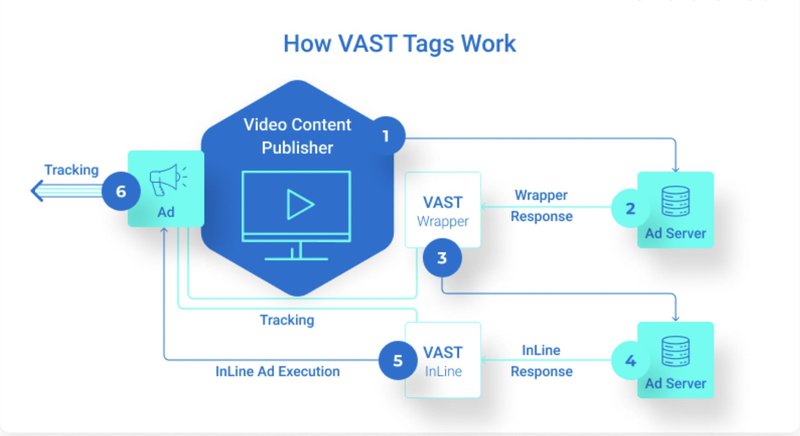
Image source: Publift
The VAST tag returns an XML (eXtensible Markup Language) document that works as a container for the ad, passed from the ad server to the video player. It lists the video files in different sizes and formats, the click-through URL and the tracking URLs the player calls as the ad plays.).

Image source: Headerbidding.co
A VAST tag is served through an ad server, which allows you to track impressions, clicks, and other data. These tags can be used with a variety of video players, including popular web browsers and mobile apps. They provide a way to deliver advertising content in a format that is compatible with most video players.
How do you implement and preview a VAST tag?
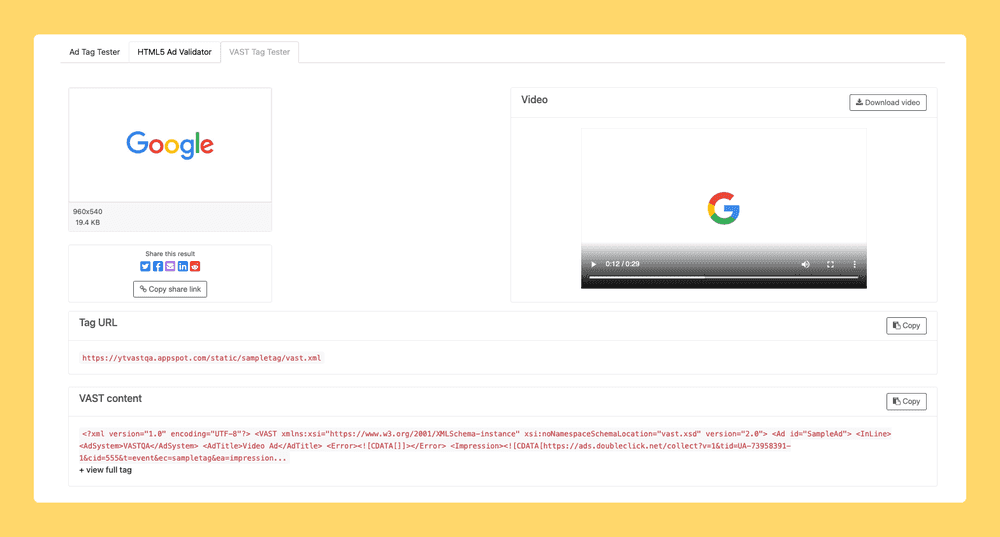
You can implement a VAST tag on your website or app by following the instructions on the IAB website or your ad platform’s help center. Once you have implemented the tag, you will need to test it to ensure that it is working properly. You can use tools like the Google’s IMA Video Suite Inspector and our free VAST tag tester at Previewads.com to preview and test your VAST tags. If you are having trouble implementing a tag, you can contact your ad network or the IAB for assistance. For additional information, check out this introduction on how a VAST tag works:
Frequently asked questions about VAST tags
What does VAST stand for?
VAST stands for Video Ad Serving Template. It’s a standard from the IAB Tech Lab that defines the XML a video player reads to know which ad to play, where its video files are and which tracking URLs to call.
What is the difference between VAST and VPAID?
VAST describes the ad and its tracking. VPAID (Video Player-Ad Interface Definition) let an ad run its own code inside the player for interactivity and measurement. The IAB Tech Lab has deprecated VPAID; newer VAST 4 setups use SIMID for interactive ads and Open Measurement for verification.
What is a VAST wrapper?
A wrapper is a VAST response that doesn’t contain the ad itself. It points the player to another ad server’s VAST tag, often so a second party can add its own tracking. The player follows the chain until it reaches an inline VAST response with the video files. Long wrapper chains slow the ad down and are a common reason video ads time out and don’t play.
How do I test a VAST tag before launch?
Paste the tag into a VAST tester, such as the free VAST tag ad tester at Previewads.com or Google’s IMA Video Suite Inspector, and check that the ad plays, the video files load and the click-through goes to the right landing page. To check many VAST tags at once, Ad Reform’s Ad Preview renders each one and captures its frames, a recording and the landing page, in the app or through the API.