Automotive Co-Op Advertising: Improving performance and efficiencies
Co-op | Ad Screenshots

Landon Bennett
Updated
If you run a car dealership, or the agency behind one, you probably use your manufacturer’s co-op program to stretch your advertising budget.
Every program comes with rules: which media qualify, how the brand and models must appear, what needs pre-approval and what proof you need to submit to get paid back.
Followed well, co-op is one of the most cost-effective ways for a dealer to advertise. Followed loosely, it means rejected claims and money left on the table.
Most of the work isn’t the ads themselves. It’s keeping every ad within the guidelines and collecting the proof the manufacturer asks for, month after month.
This article covers how co-op works, then practical ways to run it better: more reimbursed ads, fewer rejected claims and less time spent on paperwork.
What is an advertising co-op?
An advertising co-op is an arrangement where a manufacturer (OEM) pays back part of a dealer’s advertising costs, as long as the ads promote the manufacturer’s brand or models and follow its co-op guidelines. Manufacturers usually set aside co-op funds for each dealer, and the dealer claims them back after the ads run.
The advantage is more advertising for the same budget, with brand messaging that stays consistent across dealers. The catch is the paperwork: every claim needs proof that the ad ran as approved, and claims without it get rejected.
The downside is control. Your creative has to follow the manufacturer’s brand rules, some media or messages may not qualify, and unspent funds often expire at the end of the program period.
How does automotive co-op advertising work?
Automotive co-op advertising works on reimbursement. The dealer (or its agency) runs ads that follow the manufacturer’s co-op guidelines, then submits a claim with the invoices and proof of performance, such as screenshots or tear sheets that show the ad live with the page URL and date. Once the claim is approved, the manufacturer pays back its share of the cost.
How much is reimbursed, and which media qualify, varies by manufacturer and program. Manufacturers use co-op because it puts their brand into local advertising, run by dealers who know their market, at a lower cost than running all of that advertising themselves.
For dealers, the hard part is usually the claim, not the ad. Capturing screenshots by hand for every ad, every month, is slow, and a missing or wrong screenshot can cost the reimbursement.
What do manufacturers get out of co-op?
For manufacturers, co-op keeps their brand consistent in thousands of local ads they don’t run themselves. Guidelines and pre-approval let them control how models, logos, offers and disclaimers appear.
In return, dealers get help paying for advertising in their own market, where they know the buyers and the competition better than the manufacturer does.
The programs work best when both sides treat the guidelines as the starting point. Dealers who know the rules up front spend less time fixing ads and resubmitting claims.
Tips to improve your automotive co-op advertising
Most dealers already use some of their co-op funds. The gains come from using all of them, and from spending less time getting each claim approved.
Here are practical ways to make your co-op program work harder.
Run digital ads and automate the screenshots
Digital channels like Facebook, Instagram and Google let a dealer reach people shopping for a car in their local market, and they’re easier to track than print or TV.
Many manufacturers’ co-op programs cover qualifying digital ads, so check which channels and placements your program reimburses. Digital also brings more paperwork: every ad, every month, needs proof that it ran as approved.
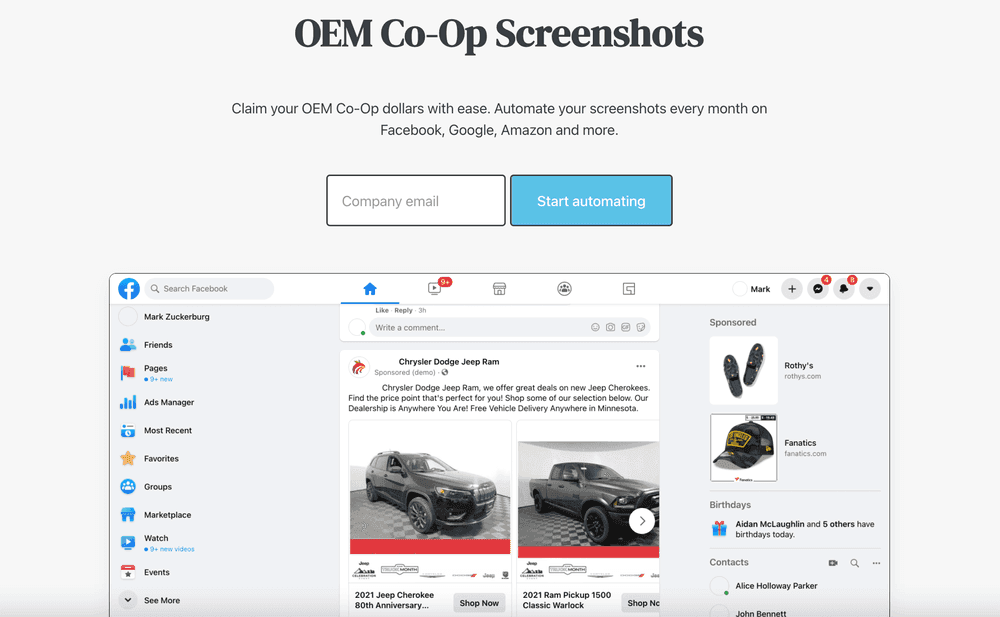
Ad Reform takes the co-op advertising screenshots off your plate on Facebook, Google and the public web, with the browser URL bar and a date and time stamp on every capture.
Know your program’s guidelines before you build ads
Read the current guidelines for each manufacturer you sell, and keep a checklist of what they require: logo and model naming, offer and disclaimer language, approved media, pre-approval steps and claim deadlines.
Ads built to the guidelines from the start get approved faster and are far less likely to be rejected at claim time.
Test your media mix
Try different channels, formats and budgets within what your program reimburses. When one kind of campaign brings more leads or showroom visits than another, shift more of your co-op funds there.
Track results by channel, so the decision is based on leads and sales, not just clicks.
Small tests also show how much time and money each channel takes before you scale it up.
Keep proof organized as you go
Don’t wait until the claim is due to gather proof. Save the invoice and screenshots for every ad as it runs, named by campaign, channel and month, so the claim is ready when the period closes.
Check each screenshot before you file: the ad, the page URL and the date should all be visible, and the ad should match the approved creative.
If a claim is rejected, read why. Correct the proof and resubmit before the claim deadline if your program allows it.
Work with the manufacturer on creative
Co-op guidelines can feel restrictive, but most programs leave room for local offers, inventory and messaging.
If you want to run something outside the usual templates, ask for pre-approval before the ad runs, not after.
Explain why the ad suits your local market, and get the approval in writing so the spend stays reimbursable.
Frequently asked questions about automotive co-op advertising
What is automotive co-op advertising?
A program where a car manufacturer pays back part of a dealer’s advertising costs when the ads promote its brand and follow its co-op guidelines. The dealer claims the money back after the ads run.
What proof do I need for a co-op claim?
Requirements vary by manufacturer, but most claims need the invoice plus proof of performance: a screenshot or tear sheet that shows the ad live, usually with the page URL and the date it ran.
How do I automate co-op screenshots?
Ad Reform captures co-op screenshots on any live website and from Facebook Ads Manager every month, with the browser URL bar and a date and time stamp, so the proof is ready when you file the claim. See how OEM co-op screenshots work.